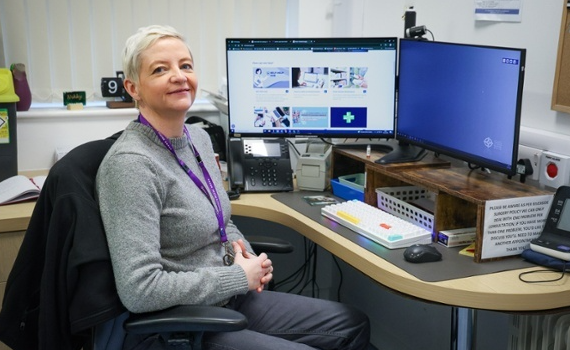
From Backlogs to Better Workflows at Hall Green Health
20 Mar
2026

With more than 30,000 patients and one of the largest GP lists in Birmingham, Hall Green Health manages a significant volume of clinical correspondence every day. As the practice continued to grow, so did the administrative workload.
Processing letters quickly while maintaining accurate clinical data was becoming increasingly difficult. Backlogs were building, staff were under pressure, and the existing process was no longer sustainable.
We spoke with Ryan, Hall Green Health’s Digital and Transformation Lead, about how the practice reshaped its approach to letter processing with BetterLetter.
Before BetterLetter: A Workflow That Wasn’t Scaling
Before introducing BetterLetter, Hall Green Health relied on a two-step process for handling clinical correspondence.
Letters arrived electronically or were scanned into the system and placed into Docman. Due to the volume of correspondence, many letters were initially filed with minimal detail simply so they were visible in the record. Coding and additional information were meant to be added later.
Ryan explains:
“After letters came in, because of the numbers that were coming through and the backlogs that were building, they would be essentially half-filed onto the system with little information. Then our coders would go back to add in additional details - it was a two-step approach, but in all honesty, that second step wasn’t happening very consistently due to demand."
This created growing inefficiencies and gaps in clinical coding across the patient record.
At the same time, the team was dealing with wider pressures around staffing and workload:
“Things like maintaining workflow staff, the ones that are processing the letters and coding that knowledge into the system, problems with backlogs building up, and recruitment.”
Ryan had already come across BetterLetter at industry events and had been following its development for a while. When he joined Hall Green Health, the timing felt right to introduce it.
“With the way that AI’s been evolving, it’s not so much optional these days but it’s more so the standard offering you need to put forward, and it felt like the time to put BetterLetter forward.”
Introducing AI Without Replacing People
Like many practices, the team initially had some concerns when they first heard the term “AI”.
Ryan recalls that the technology itself wasn’t the biggest challenge - it was the perception.
“From the team’s point of view, I think at first it was very intimidating. The minute that you say ‘AI’, it can be a very scary two letters for some people.”
There were also understandable questions from the practice’s leadership team around governance and safety.
“From the practice governance and exec team point of view, the idea of using AI was met with uncertainty.”
However, once the team started using BetterLetter, those concerns quickly faded.
“Very quickly the team learned that BetterLetter provides AI assistance, not AI as a complete replacement. After a few days, the intuitive nature of the program made them more and more comfortable with it.”
Rather than replacing staff, the system simply supported them, helping them work more quickly and with greater confidence.
Moving from Two Steps to One
One of the biggest changes BetterLetter introduced was the ability to move from a fragmented two-step workflow to a single, streamlined process.
Instead of filing letters quickly and returning to them later, staff could now process correspondence in one pass with BetterLetter providing suggestions and coding support.
This helped the practice address one of its biggest operational challenges: backlogs.
Ryan explains:
“We’ve seen productivity increase a good proportion. A more tangible benefit is that we did have a backlog that we were considering external help to work through, but because of the productivity increase from BetterLetter, we actually haven’t had to - it naturally went down.”
For a busy practice, eliminating the need to outsource backlog work was a significant operational win.
Better Oversight for Management
BetterLetter’s reporting tools also gave the leadership team greater visibility into how work was being distributed across the team.
Ryan explains how this changed day-to-day management:
“Within GP services there’s always been a question about productivity within admin teams - what is being done and why. Being able to see that in numbers day-by-day has been really helpful.”
“From a management point of view, it helps spread that workload. If someone isn’t pulling enough weight, we can look at that data and plan our next steps.”
For the first time, the practice had a clear view of processing activity and throughput.
“We have empirical evidence, not just guesstimated numbers.”
This visibility allows managers to spot bottlenecks earlier, balance workloads, and ensure the team has the support it needs.
Stronger Coding Quality
Another major improvement was the consistency of clinical coding.
Before BetterLetter, coding was often incomplete due to the pressures of the two-step workflow. With BetterLetter supporting the process, the practice saw a noticeable improvement.
Ryan explains:
“Generally the coding quality has gone up. It wasn’t being done sufficiently before, so from a consistency point of view we’ve seen that we've seen that improve.”
Better data quality also helped the practice better understand the financial impact of coding.
“I’ve seen from BetterLetter a broken down outline of the cost implications of additional coding.”
For Ryan, this insight was particularly valuable when building a business case for change.
“Things like the QOF differences in income are really hard to quantify. But doing it month-to-month, it’s actually showing it’s not just an increase at the start, but an ongoing basis of improvement.”
A Smooth Rollout and Responsive Support
Introducing new technology into clinical operations can often require careful change management. In Hall Green Health’s case, the rollout was relatively straightforward.
Ryan explains:
“We were quite fortunate because we’re quite technically enabled. Compared to other practices, we were in a better position to mitigate the change a little bit.”
The team also appreciated the support available through BetterLetter’s live chat.
“I have had comments from the team saying that the live chat feature in BetterLetter is very helpful and having someone to ask specific queries to has been very good.”
Ryan also highlights the collaborative relationship with the BetterLetter team.
“I mentioned to the team at BetterLetter that we’d like to see a bit more data around document analysis. Off the back of that, I got to join a call where the team sat down and said they were open to hearing my ideas.”
Seeing that feedback turn into product improvements reinforced the sense that the platform continues to evolve alongside the needs of practices.
“It was good to get that across and see that my feedback was taken and turned into action.”
Return on Investment and Scaling for the Future
Ryan is clear about the value BetterLetter has delivered for the practice.
“Absolutely. I mean from my perspective, I’ve seen the early days of BetterLetter, and I saw the potential in it and it’s gotten better over time.”
While other tools may appear cheaper on the surface, Ryan believes the difference lies in quality, governance, and long-term value.
“There’s products that aren’t really comparable but are cheaper, but they don’t provide the quality or holistic approach that BetterLetter does.”
He also highlights the importance of trust and compliance when handling clinical data.
“There are other document management programs on the market but there are increasingly worries about their governance and data safety and things like that. With BetterLetter, you know that it’s done right and accurately.”
With ARRS funding now in place, the practice is also able to scale its approach by accessing BetterLetter’s outsourced coding services when needed, helping ensure that quality and productivity can keep pace with demand.
For Ryan, the conclusion is straightforward:
“Once you get past the hurdle of the initial price, you can see the savings - particularly at scale. I would recommend it.”
Ready to Improve Your Letter Processing?
Hall Green Health’s experience shows how the right tools can help practices manage growing volumes of clinical correspondence while improving coding consistency and oversight.
By moving from a fragmented, two-step process to a streamlined workflow with BetterLetter, the team has reduced backlogs, strengthened data quality, and given staff more confidence in their day-to-day work.
If your practice is looking for a way to process letters more efficiently while maintaining accurate clinical data, email hello@betterletter.ai to find out how BetterLetter can support your team.